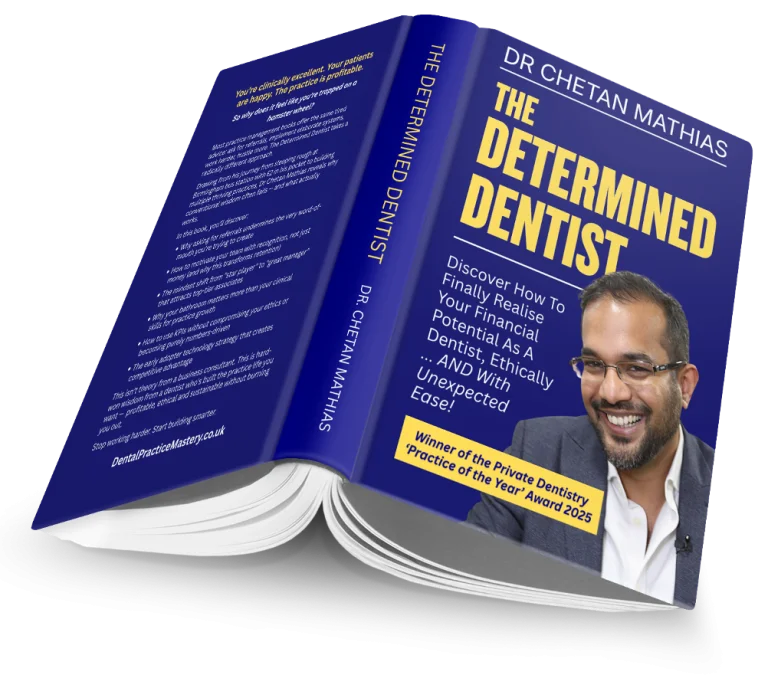
THE DETERMINED DENTIST
You didn't buy a practice so you could spend your life whacking pesky 'business moles'.
Cashflow. Recruitment. Marketing. No-shows. Associates leaving. You fix one ‘problem’ and another pops up somewhere else. I’m Dr Chetan Mathias, and I’m going to show you how to unplug the machine instead of hitting what comes out of it.
Tell me, which of these popped up for you this month?
A hygienist hands in her notice. Your best associate starts asking about equity. The Facebook ads that worked last year have stopped working. A patient argues about the price of a crown that took you two hours and eleven years of training to be able to do properly. Your accountant sends a figure that doesn’t match the one in your head.

None of these are dental problems. Nobody at dental school mentioned any of them. But every one of them lands on your desk as a practice owner — and all too regularly, I’ll bet.
Here's the bit nobody tells you: these things aren't really the problems at all.
They’re symptoms. And symptoms are exhausting to chase, because there’s always another one coming.
When I stopped fixing individual issues as they occurred and started asking what was generating them, I found the same underlying problems over and over again. Fix those and the annoying ‘moles’ stop arriving. Not because you got faster with the mallet — because there’s nothing powering the machine any more.
Stop whacking. Start unplugging.
That’s what I do with the practice owners I work with now. And pulling the plug is usually simpler than they’re expecting.


I'm not a business consultant who read a book about dentistry.
I qualified overseas and arrived here with no network, no reputation and no idea how any of this worked. I couldn’t have told you what EBITDA stood for. I assumed that if I was good enough clinically, the business side would look after itself.
It did not look after itself.
Since then I’ve built and run [number] private practices. I’ve employed [number] people. I’ve done the payroll, the CQC inspections, the associate contracts, the awkward conversation with the bank, and the even more awkward one with the practice manager.
Everything I teach, I tested on my own money first. And one test at a time it finally paid off — last year I was named Private Dentist of the Year.
I mention the award not to brag, but to show you that no matter where you start from, as a Determined Dentist there really is no limit to what you can achieve or where you can end up.
Three foundations you can implement quickly.
Motivate with medals, not moolah.
Napoleon worked out that men will die for medals. Your team won't die for you, but they will bring their A game — and it costs about forty-five seconds a day, not a pay rise.
Stop bragging that you can bend it like Beckham.
Great players want to play for great managers, not compete with them for every shot on goal. If you want premier league associates, you have to stop being the star striker.
Market to repel Practice Parasites.
Roughly a fifth of your patients bring most of your revenue and most of your joy. Another fifth drain both. Most marketing attracts all of them equally. Yours doesn't have to.
These 3 foundations are discussed fully in my book, along with implementation plans and downloadable resources.
SO, are you a Determined Dentist?
Determined - adjective

having made a firm decision and refusing to let anyone or any difficulty stop you.
to
Start the Determined Dentist journey wherever you like.
Read the book
The Determined Dentist book details my philosophy and somewhat unique practice growth methodology. Start here if you want to see if we think the same way.
Come to Determined Dentist Live
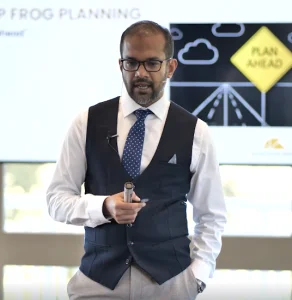
Over two days without a single slide about synergy. You’ll leave inspired and with solid ideas you can implement in your practice straight away.
Work with me directly
By application. Limited availability. To be considered, you must have read the Determined Dentist book or attended Determined Dentist Live first.
What actually changes for Determined Dentists.


Four things you might be thinking right now.
"I don't have time for this."
I know. That’s not an excuse, it’s a diagnosis.
But you’re already spending the time. You spent it last month on the recruitment crisis, and the month before on the cashflow wobble, and you’ll spend it again in six weeks on whatever pops up next. Finding that time isn’t optional — when it’s needed, you simply find it.
The difference is that time spent on symptoms buys you nothing permanent. You do it again, and again, and again.
I won’t pretend the first month costs you nothing. There’s thinking to do and some of it is uncomfortable. But it’s broadly the same hours you’re already losing — spent once, instead of repeatedly.
"I've paid a consultant before. I got a folder."
Probably a very thick one. Possibly with a section on synergy.
I’d struggle to tell most dental consultants apart, and I’m in the profession. Same website, same six pillars, same photograph of a model in scrubs who has clearly never held a handpiece.
So here’s my honest differentiator. I’m not a business person who learned to say “occlusion” in meetings. I’m a dentist who built practices, got a great deal of it wrong the first time, and worked out what actually moved the numbers. When I tell you something works, it’s because it worked in my surgery — not because I read it somewhere.
And I’m not going to give you a folder. Folders don’t change practices. Implementation does, and it’s a slower and far less impressive-looking thing to sell.
"Is this about squeezing more money out of patients?"
No. And I’d be asking the same question if it was me reading this page.
Look at what’s actually in the three foundations. The first is about recognising your team properly. The second is about how you position yourself among other dentists. The third is about which patients your marketing attracts in the first place.
Not one of them is about the person currently sitting in your chair. There’s no script, no upsell, no clever way to talk someone into a crown they don’t need.
My view — and the book argues it at length — is that the tension you feel between looking after patients and running a profitable business is mostly imaginary. The single most profitable thing I have ever done is be very good at dentistry and let people tell their friends. I don’t even have a referral system. I think referral schemes cheapen the very thing they’re trying to capture.
"I don't need a 'stand-up Routine'. I need my numbers fixed"
Agreed. And I might think the same thing looking at a page with someone using props and dramatics to talk about business problems.
Here’s my defence. I once delivered a conference presentation dressed as Napoleon Bonaparte. Full costume, in front of several hundred colleagues. A year later, I regularly meet people who can still tell me exactly what my presentation was about and what they did because they could remember it.
You’ve sat through dozens of extremely serious talks on practice growth. You understood almost all of them. How many did you implement?
That’s not a failure of discipline on your part. It’s a failure of the presenter and most often their delivery. Dry content gets understood and forgotten. Education + edutainment gets remembered — and things that get remembered very often get done.
So yes, my ‘edutaining’ approach is deliberate. Underneath these stunts and props is a serious framework I’ve used to build multiple private practices, and last year the profession saw fit to name me Private Dentist of the Year.
The moles aren't going to stop on their own.
Get the book — it’s on me. If it doesn’t sound like someone who understands the business you’re actually running after reading the first chapter, you’ve lost nothing but the postage and 20 minutes of your time.
But if you are who you think you are, this is the first step towards transforming both the results you get and your experience of being a dentist.